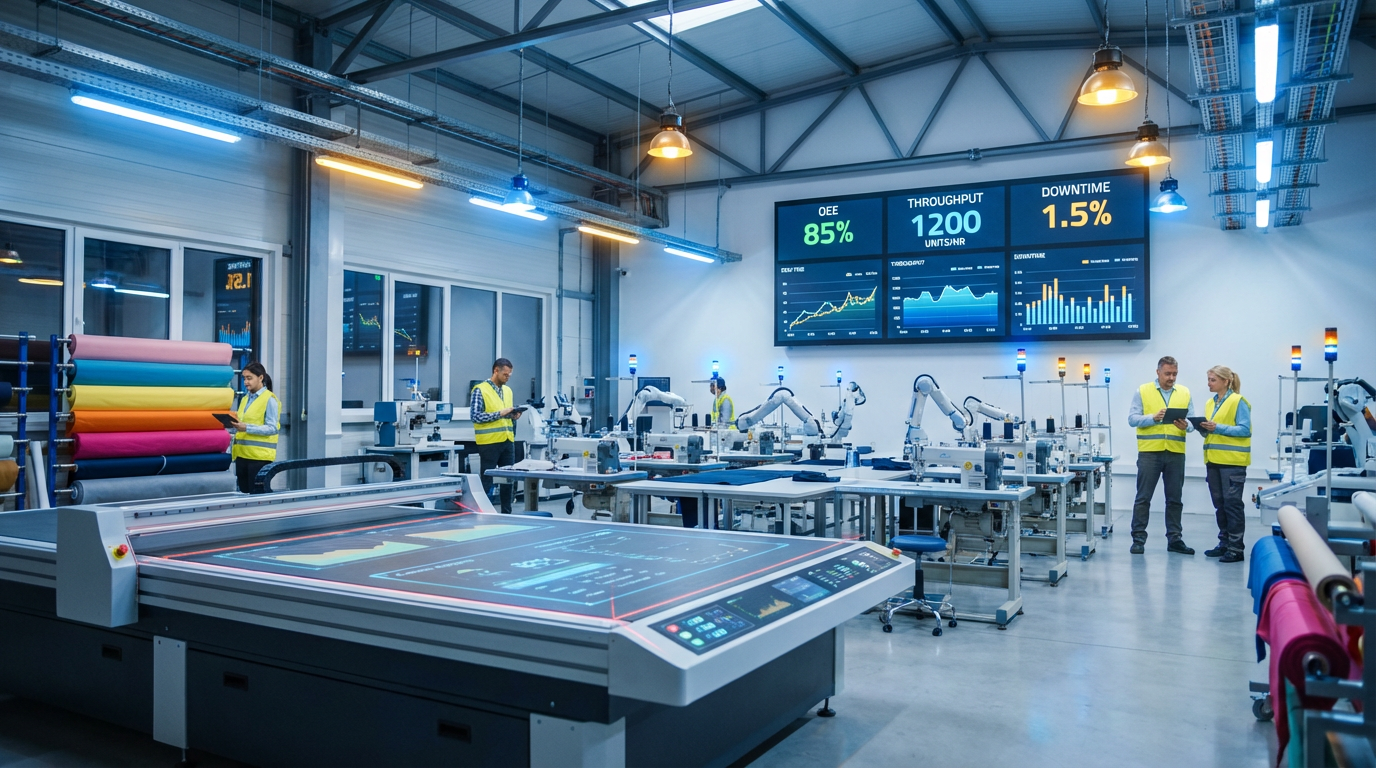
Apparel manufacturing is a $1.5 trillion global industry — yet most factories still rely on paper-based tracking, manual cut-order planning, and reactive maintenance. When a leading global apparel manufacturer approached us, they had a clear vision: transform their production floor from guesswork into a data-driven operation.
Over 6 months, we designed and deployed an end-to-end smart manufacturing platform that combined Industrial IoT (IIoT) sensor networks, custom machine learning models, and a real-time production dashboard — delivering measurable results from week one.
The Challenge: Blind Spots Everywhere
The manufacturer operated multiple production lines across two facilities, producing garments for major retail brands. Despite significant throughput, they faced several critical pain points:
- No real-time visibility — Production managers relied on end-of-shift paper reports. By the time they saw a problem, an entire shift of defective output had already been produced.
- Manual cut-order planning — Planners spent 3-4 hours per day manually optimizing fabric layouts in spreadsheets, with significant material waste.
- Untracked downtime — Machine stoppages weren't logged. Nobody knew whether a line was down for 5 minutes or 50.
- Reactive quality control — Defects were only caught at end-of-line inspection, after the damage was done.
- Demand volatility — Seasonal swings and fast-fashion cycles led to overproduction or stockouts.
Our Approach: Measure, Model, Monitor
Inspired by Industry 4.0 principles and production monitoring platforms like Raven.ai, we built a three-phase deployment strategy — but tailored specifically for the complexities of garment manufacturing, where production lines aren't uniform conveyor belts but a mix of cutting, sewing, finishing, and packing stations.
Instrument & Measure
Deploy IIoT sensors across critical machines and workstations. Establish baseline OEE, downtime patterns, and throughput metrics for every line.
Model & Predict
Train ML models on collected data — demand forecasting, quality defect prediction, and fabric utilization optimization. Feed predictions back into planning.
Monitor & Optimize
Deploy real-time dashboards on the factory floor. Automated alerts for anomalies. Continuous feedback loops that get smarter over time.
Phase 1: IIoT Sensor Deployment
The foundation of any smart factory is data — and you can't analyze what you don't measure. We selected and deployed a mix of industrial-grade IIoT sensors designed for the garment manufacturing environment, starting with the most impactful measurement points.
Key Sensor Types Deployed
Vibration & Cycle Sensors
Attached to sewing machines, cutting tables, and pressing units. Detect machine running/idle/off states and count production cycles per minute.
Accelerometer Non-invasive Battery-poweredThermal & Humidity Sensors
Monitor ambient conditions on the production floor. Critical for fabric quality — certain textiles behave differently in high-humidity environments.
DHT22 / BME280 LoRaWANOptical Piece Counters
Mounted at end-of-line stations to automatically count finished garments as they pass. Eliminates manual tallying and provides real-time throughput data.
IR Beam Break Edge ComputePower Monitoring Clamps
CT clamp sensors on machine power lines. Detect energy consumption patterns that correlate with machine health and identify standby vs. active power draw.
CT Clamp Modbus Non-invasiveAir Quality & Particulate Sensors
Monitor dust and fiber particulate levels — both for worker safety compliance and as an indirect indicator of cutting machine performance.
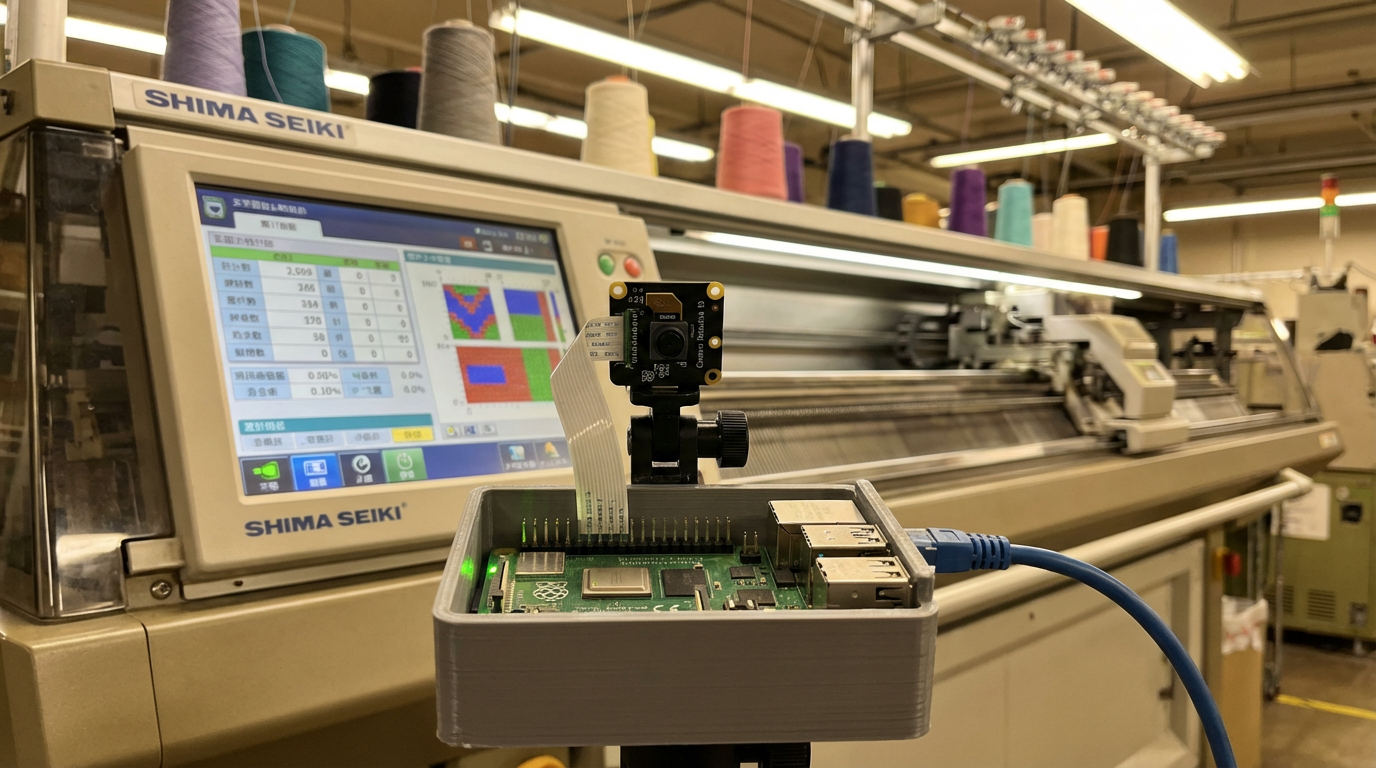
PM2.5/PM10 OSHA ComplianceRaspberry Pi Camera Modules
Pi Camera V3 modules mounted facing Shima Seiki knitting machine displays. Captures screen data via OCR — production counts, error codes, pattern status — without any integration into the machine's proprietary software.
Raspberry Pi 4 Pi Camera V3 OCR / TesseractAll sensors feed into a local edge gateway (Raspberry Pi 4 or Intel NUC per production line) that aggregates, buffers, and forwards data to our cloud platform via MQTT. This ensures data is captured even during internet outages — a common occurrence in factory environments.
Phase 2: Custom ML Models
With sensor data flowing, we built four purpose-built machine learning models to transform raw signals into actionable intelligence.
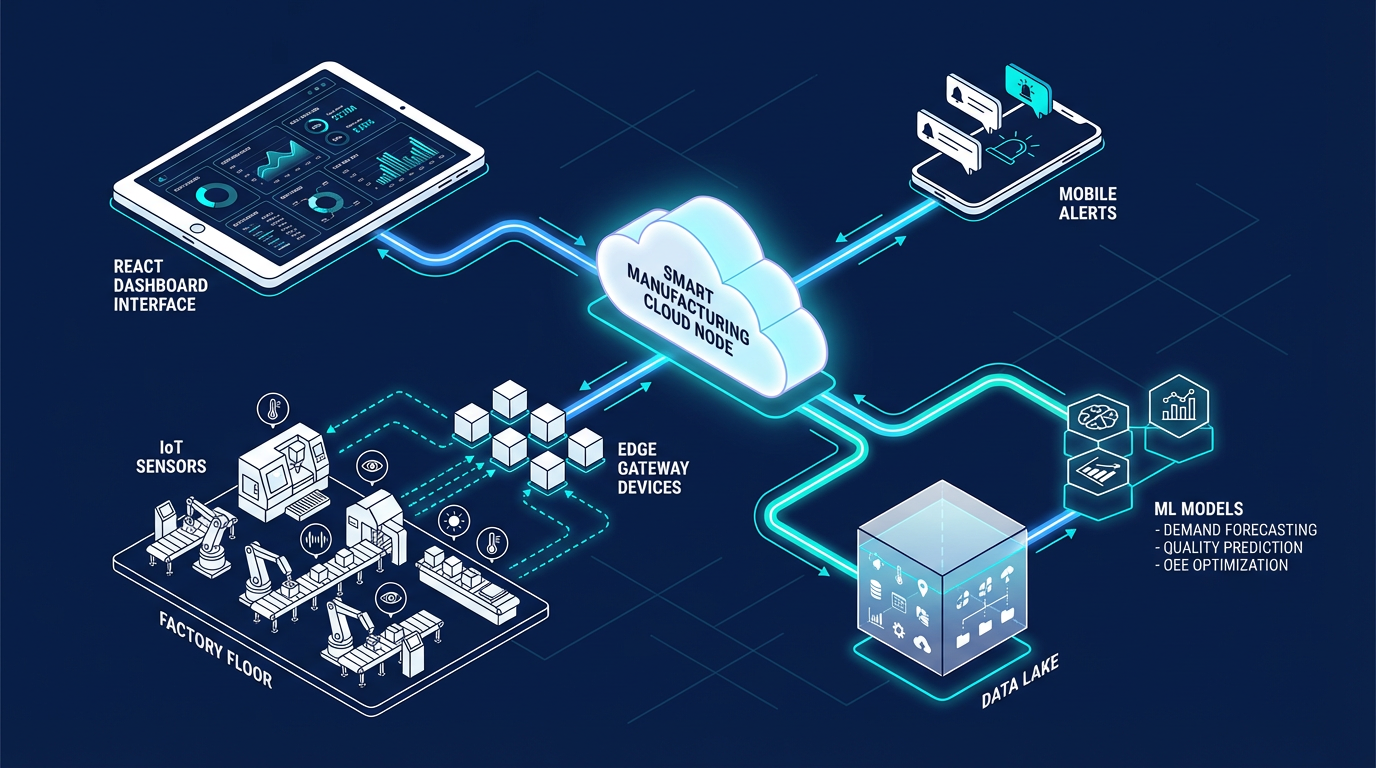
📈 Demand Forecasting
Time-series model that predicts order volumes 4-8 weeks ahead by combining historical sales data, seasonal patterns, retail partner sell-through rates, and external signals (weather, fashion trend indices).
✂️ Cut-Order Optimization
Constraint-based optimization model for fabric nesting — maximizes material utilization across multi-size, multi-color cut orders. Replaces 3-4 hours of manual spreadsheet planning per day.
🔍 Defect Detection
Computer vision model running on edge devices at inspection stations. Detects 12 defect categories (broken stitch, skip stitch, puckering, color variance, etc.) with sub-second inference.
🔧 Predictive Maintenance
Anomaly detection model trained on vibration and power consumption patterns. Predicts machine failures 24-72 hours before breakdown, enabling scheduled maintenance during planned downtime.
Phase 3: Real-Time Production Dashboard
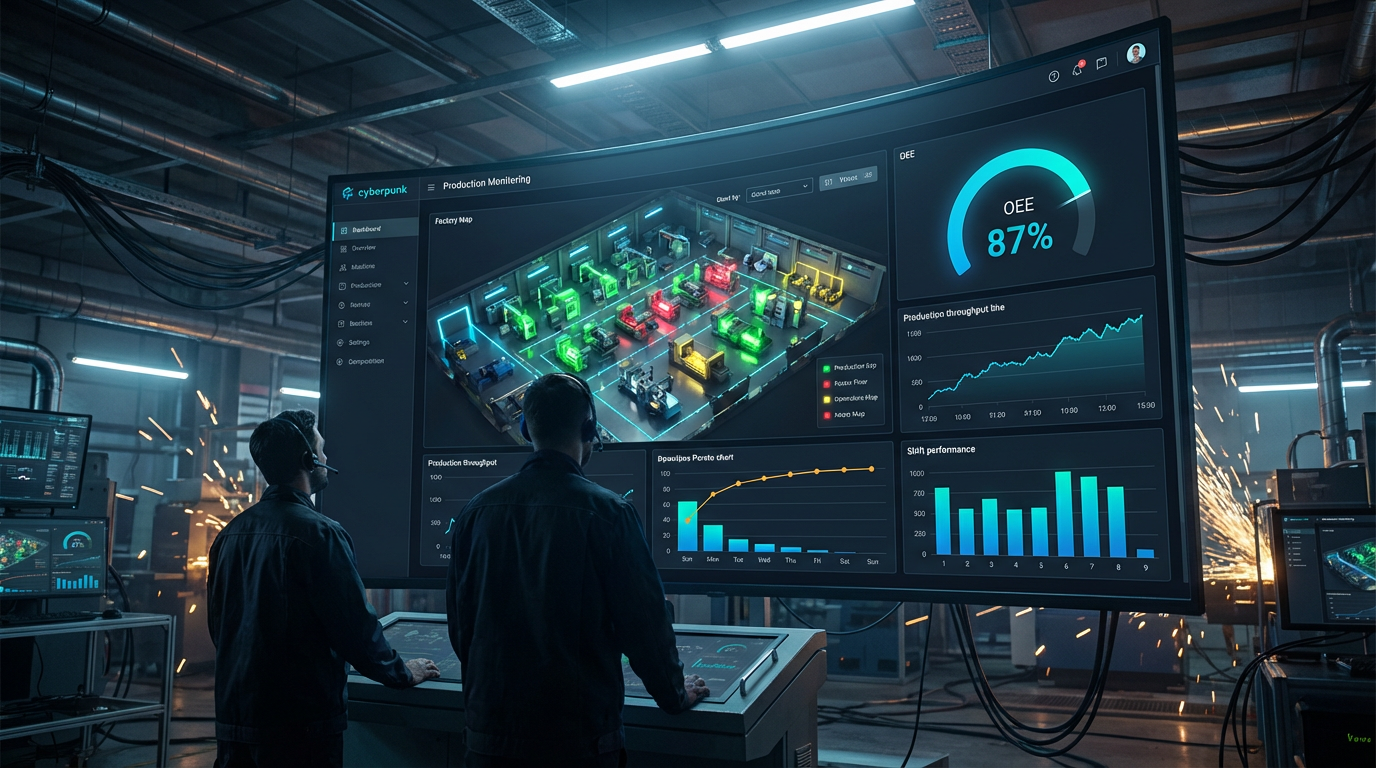
Data and models are only valuable when they reach the right people at the right time. We built a three-tier dashboard system — factory floor displays, supervisor mobile app, and executive analytics — each showing the right level of detail for its audience.
Floor-Level Displays
Large-screen dashboards at each production line showing real-time OEE, current shift progress vs. target, and color-coded machine status (green = running, red = down, yellow = idle). Operators can see immediately whether they're winning or losing the shift — a gamification approach inspired by frontline engagement patterns from shop floor monitoring best practices.
Supervisor Mobile Alerts
Push notifications to line supervisors when: a machine goes down for more than 5 minutes, quality defect rates spike above threshold, or throughput drops below target pace. Each alert includes suggested root causes based on historical patterns.
Executive Analytics
Weekly and monthly roll-up reports: cross-facility OEE comparison, top losses Pareto analysis, demand forecast accuracy tracking, and material utilization trends. Accessible via web dashboard — no more waiting for end-of-month spreadsheet reports.
Implementation Timeline
Discovery & Sensor Selection
Factory walk-throughs, process mapping, sensor vendor evaluation, edge gateway architecture design. Identified 6 sensor types across 4 critical measurement points.
Pilot Line Deployment
Instrumented one production line (12 machines) as proof of concept. Established data pipeline from sensors → edge → cloud. Validated data quality and sampling rates.
Dashboard & Baseline Metrics
Built React dashboard with real-time WebSocket updates. Established OEE baseline (was 68%), identified top 5 downtime categories. First data-driven improvement actions taken.
ML Model Training & Cut-Order Optimizer
Trained demand forecasting and cut-order optimization models. Deployed fabric nesting optimizer — immediate 35% waste reduction on first production runs.
Full Facility Rollout
Extended sensor deployment to all production lines across both facilities. Deployed defect detection cameras and predictive maintenance models.
Optimization & Handoff
Fine-tuned models with 5 months of production data. Trained internal team on dashboard operation and alert management. OEE reached 87% (up from 68%).
Tech Stack
- Edge: Raspberry Pi 4, Intel NUC, NVIDIA Jetson Nano
- Protocols: MQTT, Modbus, LoRaWAN
- Backend: Python, FastAPI, Celery, Redis
- ML: TensorFlow, YOLOv8, XGBoost, Prophet, OR-Tools
- Frontend: React, WebSocket, D3.js
- Cloud: AWS (IoT Core, SageMaker, S3, RDS)
- Database: PostgreSQL, TimescaleDB (time-series), Redis (caching)
- AI: Claude API for natural-language production summaries and anomaly explanations
Results After 6 Months
- OEE improved from 68% to 87% — a 28% relative improvement
- Fabric waste reduced by 35% through ML-optimized cut-order nesting
- Planning time reduced by 60% — from 3-4 hours/day to under 1 hour
- Unplanned downtime reduced by 45% through predictive maintenance alerts
- Quality defect escape rate dropped by 70% with real-time vision inspection
- Full ROI achieved in under 5 months from material savings alone
Ready to Modernize Your Factory?
Whether you're running apparel, food & beverage, or discrete manufacturing — our team can design an IIoT + AI solution tailored to your production environment. Start with a free assessment.
Get Your Free Factory Assessment